ALPINE DESCENT
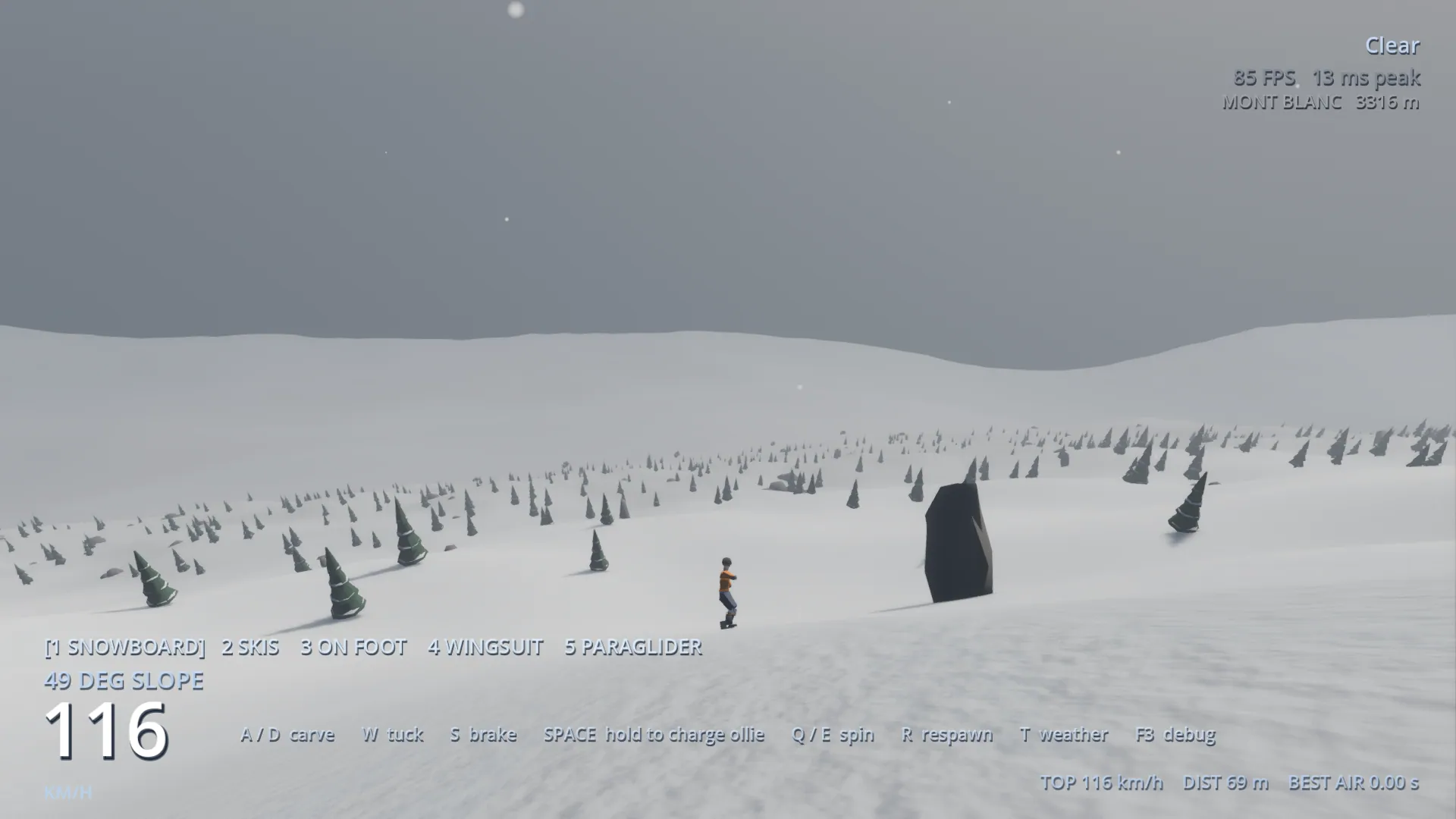
Sixteen kilometres of procedural Alps. Five massifs, a valley floor at 1000 m, summits past 4600 m. Point the board downhill and go.
This is a Windows game — open this page on a computer to download it.
Sixteen kilometres of procedural Alps. Five massifs, a valley floor at 1000 m, summits past 4600 m. Point the board downhill and go.
A whole mountain range to ride.
Two hundred and fifty-six square kilometres of terrain, generated from an analytic height field rather than a heightmap image — so collision, prop placement and the respawn logic all sample the same surface and cannot drift apart. Five named massifs stand over a 1000 m valley floor: Mont Blanc, Les Aiguilles, Aravis, Tyrol and the Vallée Blanche.
Detailed terrain streams in 96 m chunks around you with real trimesh collision; everything beyond that is drawn from a single coarse mesh of the whole range, which is what lets a distant summit actually be there. The snow has physical depth — ground shallow enough to hold it is displaced upward, so the snow line is a step you can see in silhouette and the board settles into powder rather than skating on paint.
Every map is checked by a tool that releases a rider from a grid of start points and integrates them downhill under the game's own forces. A basin that traps you is invisible in a screenshot and fatal in play.
Three separate physics models: edges, wings and legs.
An edge on snow, a wing in air and legs on a hill have nothing mechanically in common. Switching is gated on being stopped — you cannot unstrap from a board and click into skis at 100 km/h, and letting you do it would make the choice weightless.
| Item | Behaviour | Measured |
|---|---|---|
| Snowboard | Deep carves, heavy speed scrub, forgiving in the air. | 163 km/h |
| Skis | Two edges: more grip, far less scrub, faster in a line. | 188 km/h |
| On foot | Walks at 17 km/h and climbs to 42°. The only way back uphill. | 42° climb |
| Wingsuit | Fast, shallow glide. Needs a drop, punishes a flare. | 1.8 : 1 at 185 km/h |
| Paraglider | Slow and floaty. Crosses a valley from a modest launch. | 12.6 : 1 at 39 km/h |
Every figure above is measured by an automated test that flies each craft and integrates the result, not taken from the configured ceiling — drag and friction settle a rider well below whatever cap the profile allows.
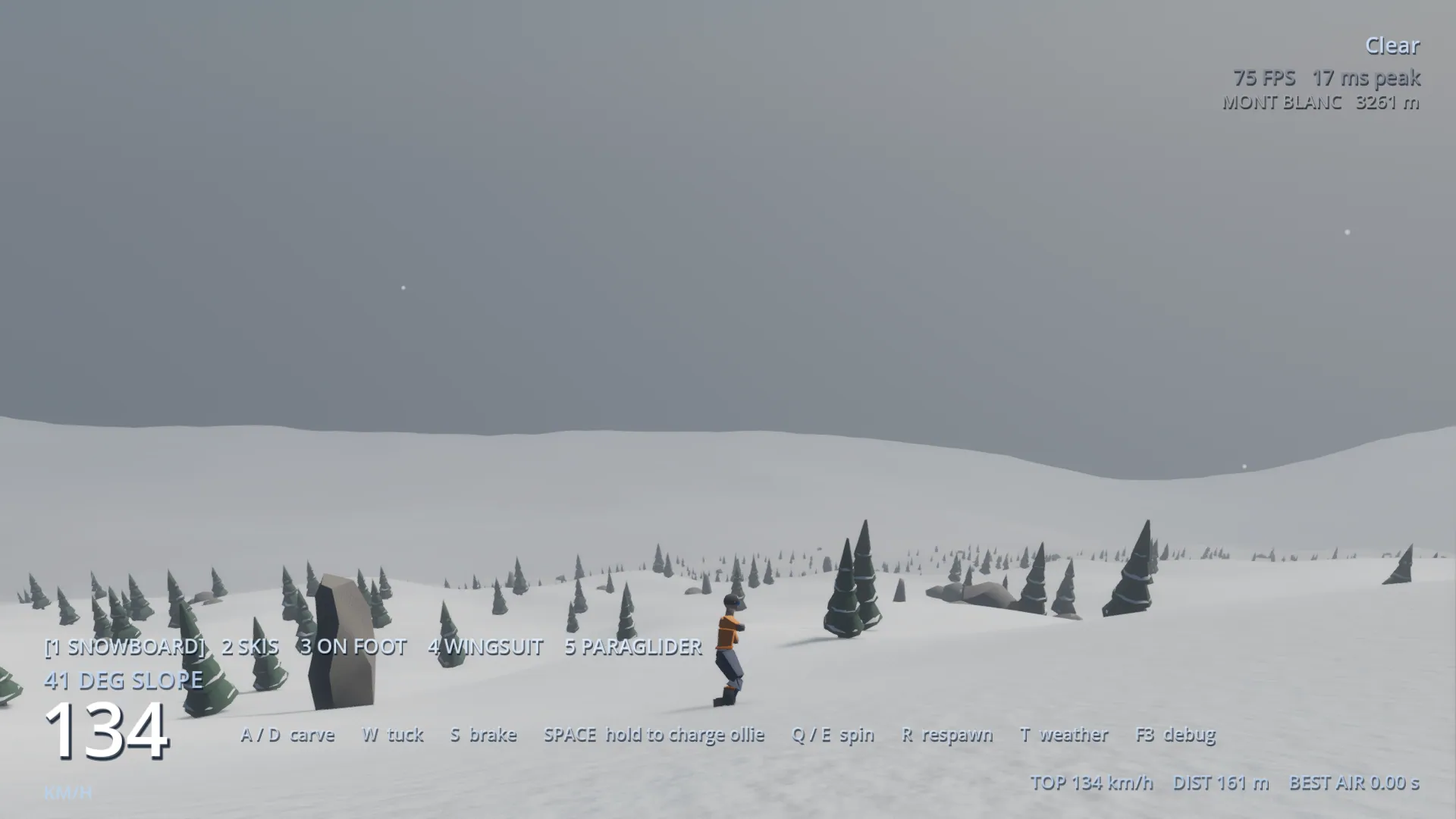
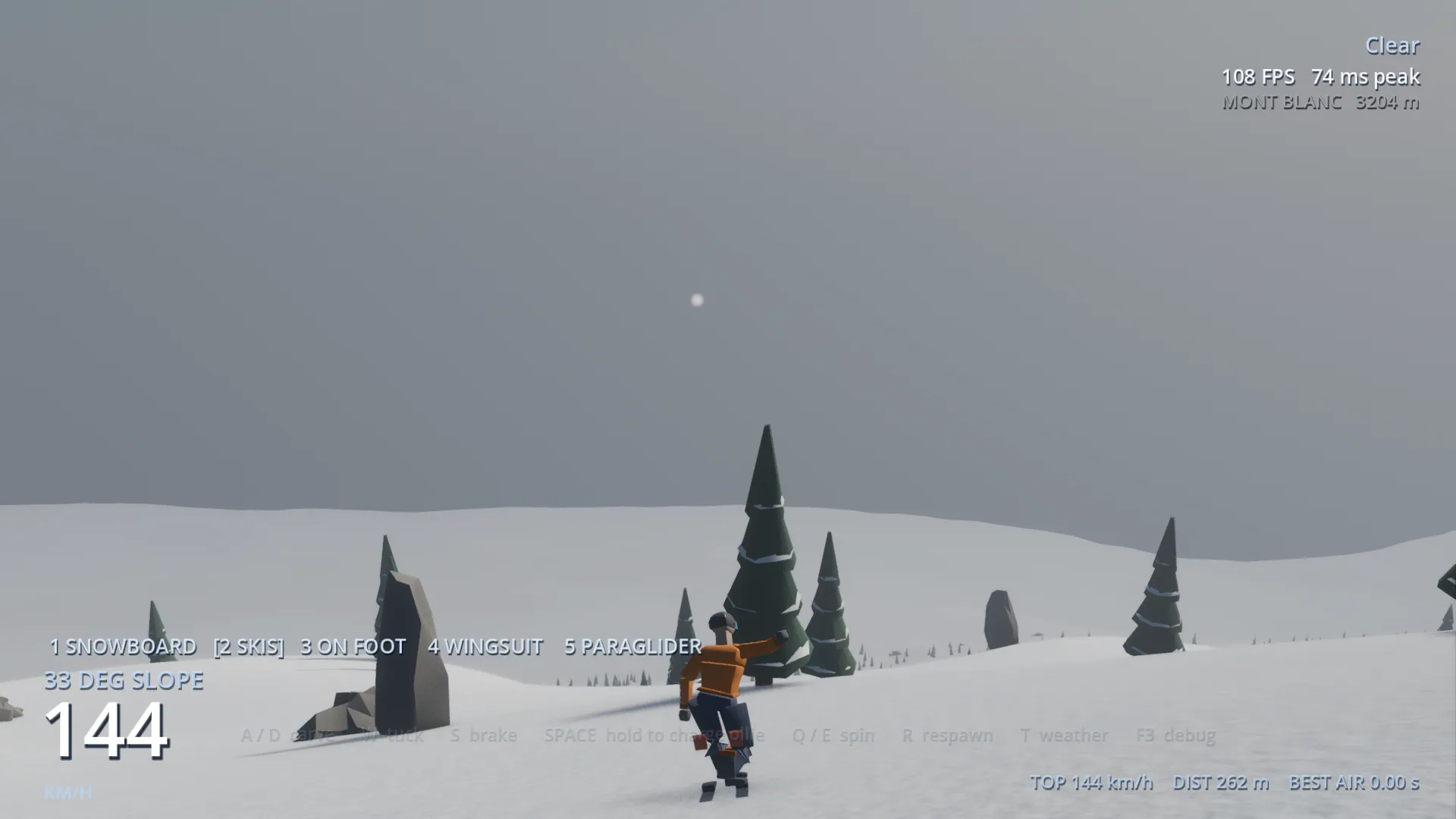
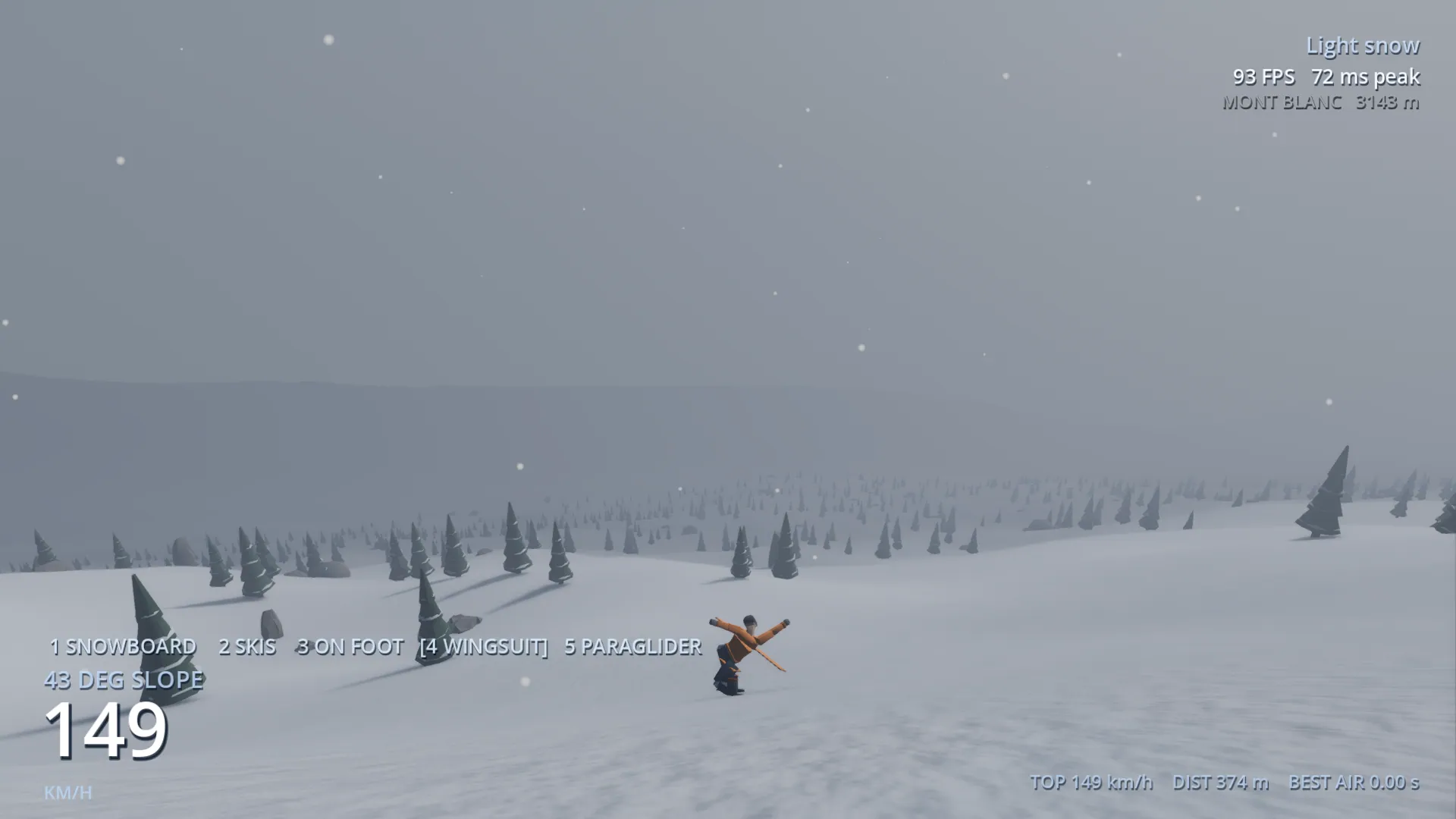
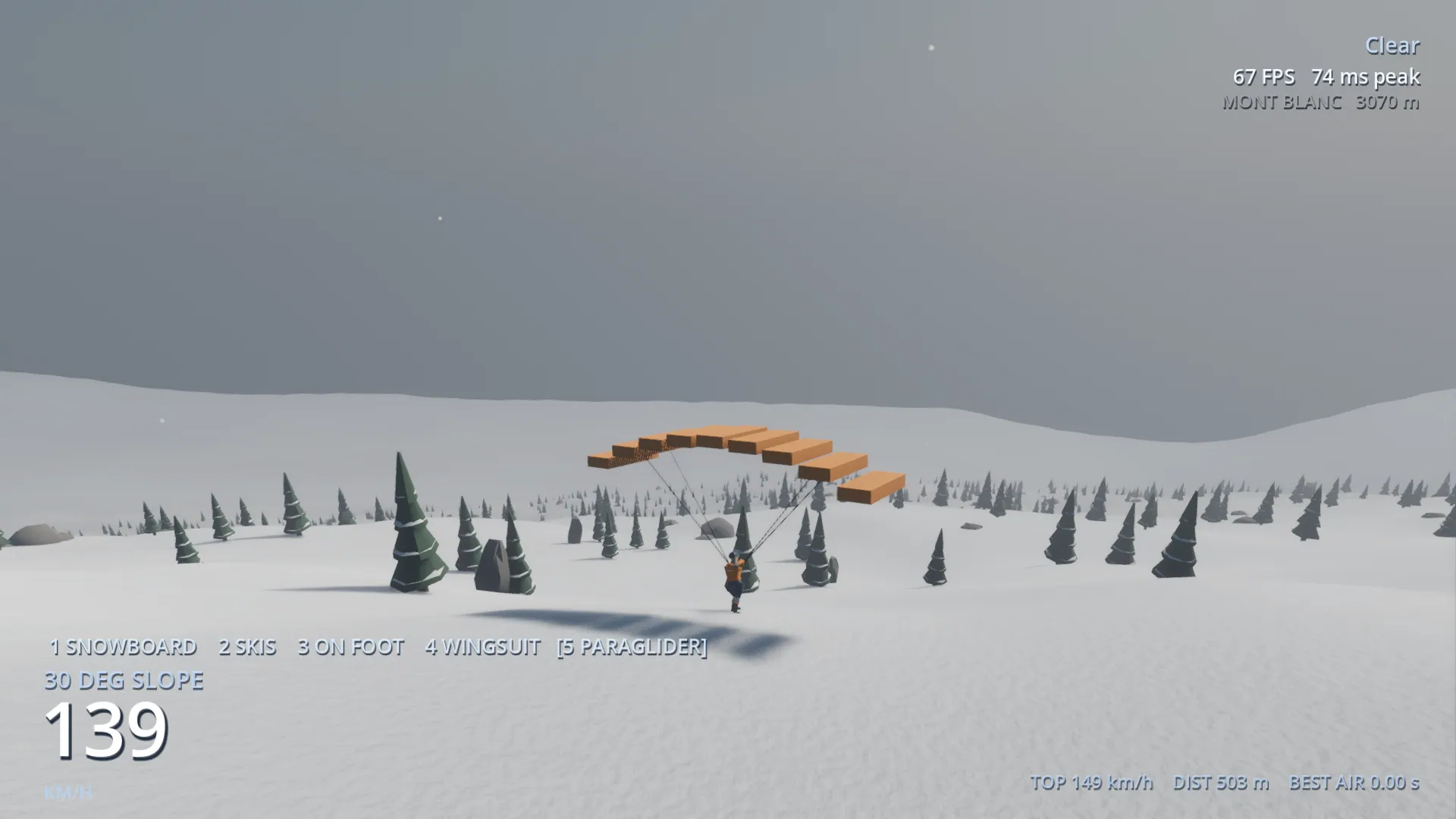
Keyboard or gamepad.
Godot 4.7 and Blender 5.2, no purchased assets.
Every model is generated by a Python script run in Blender headlessly and exported to glTF — the rider, the board, skis, wingsuit and canopy, rocks, conifers, chalets, campfires and course furniture. Running the whole asset library is one command, and each asset stays reproducible.
The rider is box-modelled: rectangular cross-sections swept along a path and filleted, sized from the 8-head figure canon, with three edge loops through every joint. Limbs are not circular, and a body built from cylinders reads as a set of pipes. The legs are IK-locked to the board so the boots stay in the bindings, then baked to plain curves because glTF carries no constraints.
Terrain, snow, rock and ice are one shader with no texture files at all — detail comes from noise generated at load. Five automated checks run the game headlessly and assert that the physics, streaming, state machines, equipment and terrain drainage all still work.